Ten Years of Collegiate Rocketry Heritage
NASA Student Launch is an eight-month research-based challenge for university rocketry teams. Students design, build, and launch complex high-power launch vehicles with scientific and engineering payloads, culminating in flight operations at NASA Marshall Space Flight Center in Huntsville, Alabama.
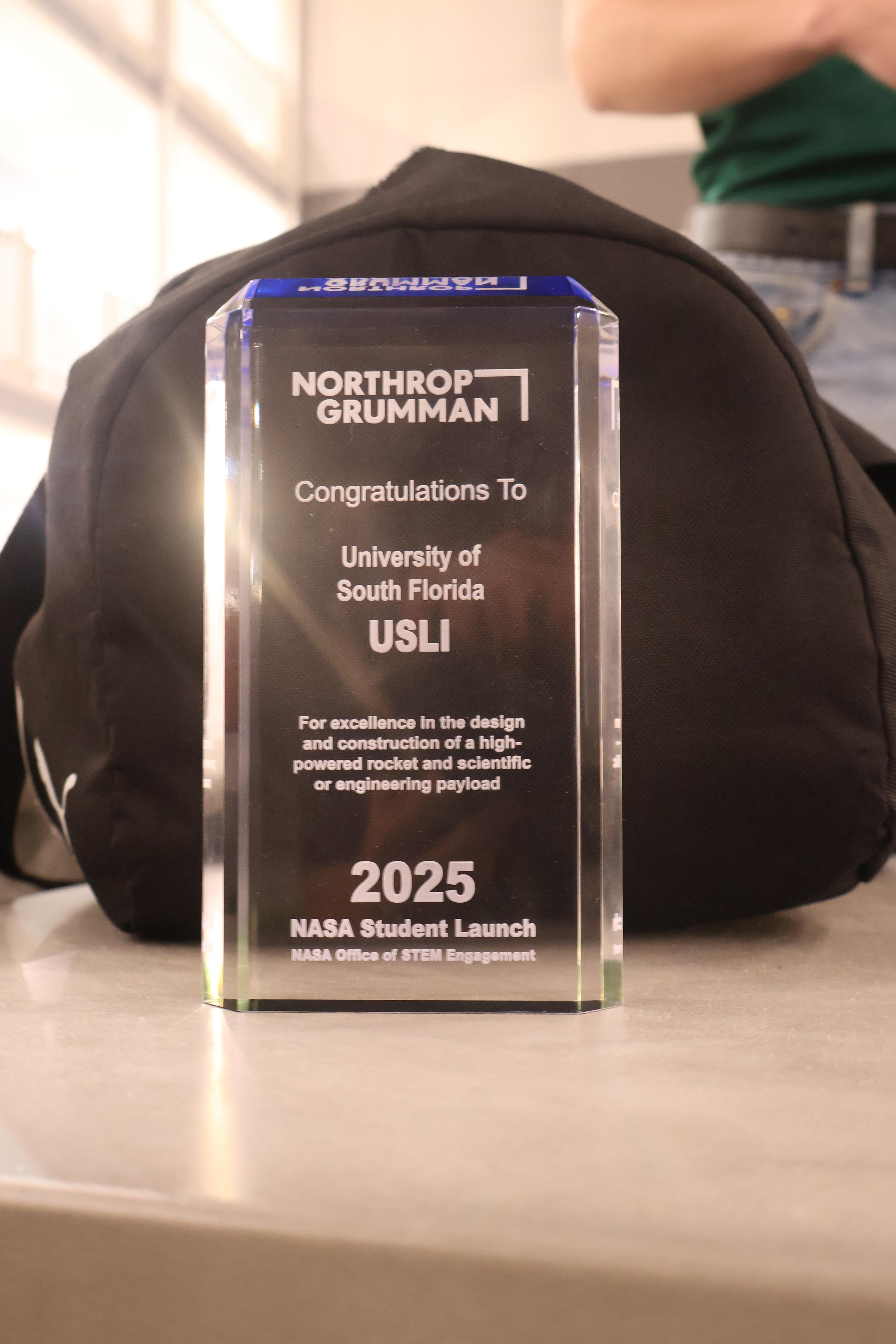
4,075 ft Target Apogee, G.O.S.T. Atmospheric APRS Transmitter & Dual Active Airbrakes
For the 2024–2025 NASA Student Launch competition, USF SOAR designed and manufactured a 97.77-inch, 6.17-inch OD high-power rocket powered by a Cesaroni L995 motor targeting a precise apogee of 4,075 ft AGL. The vehicle incorporates the Ground Observation Signal Transmitter (G.O.S.T.) primary payload—an atmospheric research laboratory inside the coupler featuring servo-actuated deployable doors that sample ambient pressure, temperature, and humidity with Adafruit BME280/BME680 sensors and broadcast live telemetry to NASA's ground station via 2M APRS (144–148 MHz). Flight performance is governed by dual active airbrake flaps driven by a Kalman filter and RK4 numerical apogee prediction loop, dual-deployment Fruity Chutes recovery (18" drogue and 96" main), a 3.0 lb adjustable ballast bay, and an onboard STEMnaut capsule carrying a Lego astronaut, Haribo gummy bear, and team mascot.
Mission Photos & Media (1 of 7)
Technical Specifications
USLI Configuration- •G.O.S.T. Sealed Coupler Bay: Internal 21g servo mechanism opens bay doors mid-flight without compromising vehicle structural continuity, allowing ambient airflow over BME280/BME680 sensors before resealing.
- •2M APRS Ground Broadcasting: Custom DRA818v RF module paired with a Radioddity RA12 antenna transmits formatted AX.25 APRS telemetry packets (144–148 MHz) directly to NASA reception terminals.
- •Autonomous Dual-Flap Airbrakes: State machine utilizing a Kalman filter, IMU/barometric sensor fusion, and Runge-Kutta 4th order (RK4) trajectory forecasting continuously commands drag flaps to zero in on 4,075 ft.
- •STEMnaut Environmental Capsule: Compact 3"×3" cylindrical capsule securing a Lego astronaut, Haribo gummy bear, and team mascot against launch and deployment G-forces.
- •Subscale & Full-Scale Flight Milestones: Verified aerodynamic stability and dual deployment during December flight demonstrations at Varn Ranch (Plant City, FL), supported by snap-force simulations and tensile proof tests.
4,500 ft Target Apogee & In-Air Deployable 'SAIL' Autonomous Quadcopter Lander
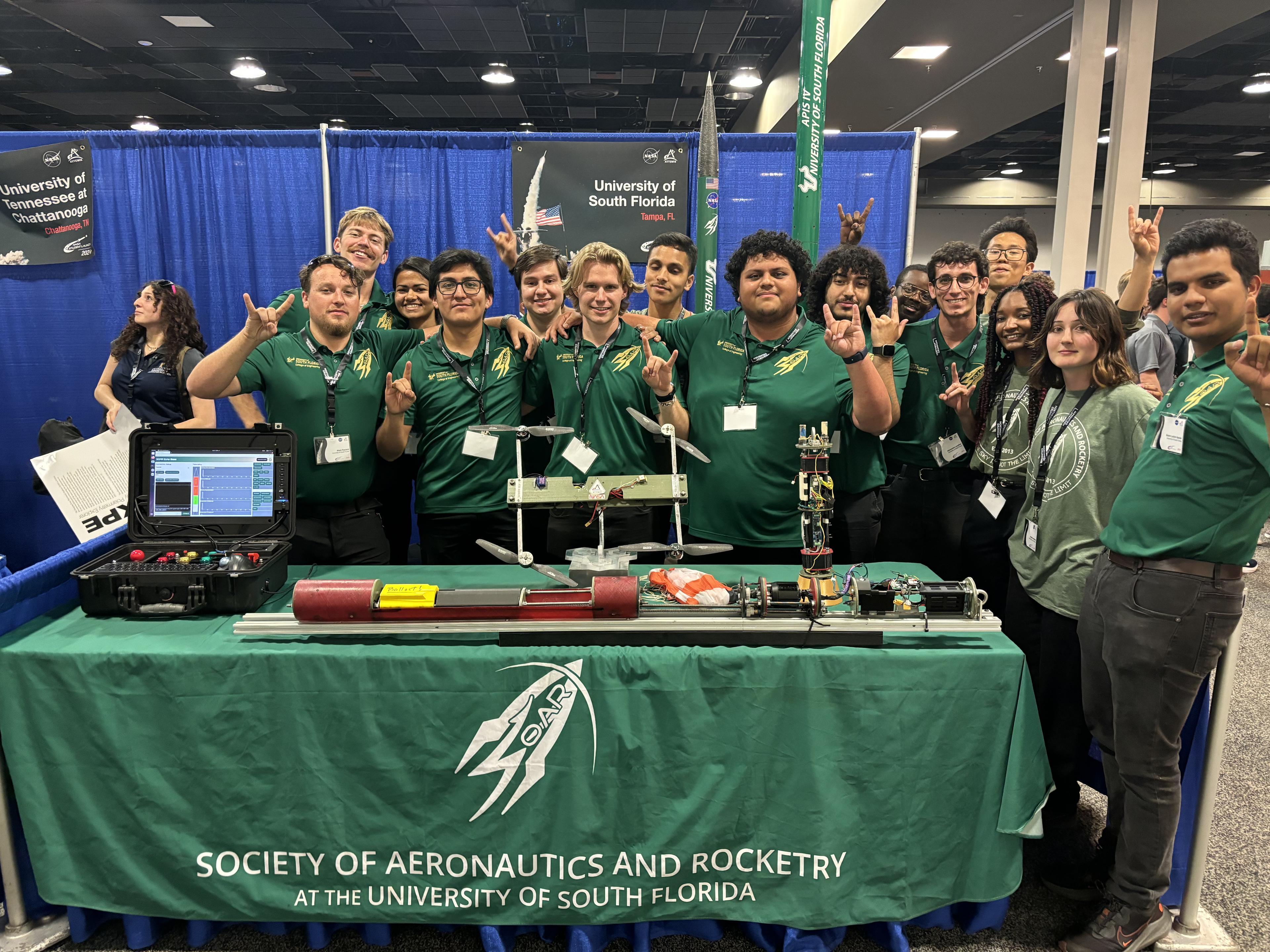
SOAR's 2023–2024 competition vehicle, APIS IV, was a 128-inch G12 fiberglass rocket powered by a Cesaroni Pro75 L995 'Red Lightning' motor targeting 4,500 ft AGL. The vehicle incorporated an in-air deployable quadcopter lander—the STEMnauts Atmosphere Independent Lander (SAIL). At apogee, dual counter-rotating ACME lead screws extended the nose cone to expose a 180° airframe window, allowing the spring-jettisoned quadcopter to deploy mid-descent (400–800 ft AGL), unfold its arms, and autonomously navigate simulated crew members ('STEMnauts') to a soft landing while monitoring strict human survivability metrics.
Mission Photos & Media (1 of 5)
Technical Specifications
USLI Configuration- •Dual Lead Screw Extension (<20s): NEMA 17 stepper and acetal gear train drives right- and left-handed ACME lead screws simultaneously to eliminate torsional twist, opening a 180° cutout window at apogee (and reversing to close if descending below 300 ft without RSO approval).
- •In-Flight Spring Jettison: Folded quadcopter sits on 3D-printed guide rails atop twin compressed springs (8.72 lbf/in constant); LoRa-actuated servos retract locking pins between 400–800 ft AGL to launch the drone clear of the airframe.
- •Auto-Deploying Carbon Arms & Failsafe: 120° torsion springs snap 4 carbon-fiber tube arms to 90° upon exit; dual servos release a spring-loaded vented plunger deploying a 36" backup parachute if stabilization or battery thresholds fail.
- •Ground Station LoRa Mesh: Teensy 4.0 reads live RRC3 altimeter and GPS data, feeding an Arduino Nano with 433 MHz Adafruit RFM96W LoRa to stream real-time GIS mapping and telemetry plots to a Python Flask web server via WebSockets.
- •Subscale Testing Lessons (Plant City, FL): Three 75%-scale flights on J760/J355 motors prompted standardized parachute folding, secure battery retention bars, and a compartmentalized hardware organizer after early flights suffered chute tangling and detached couplers.
Autonomous Servo Stabilized Camera System (SSCS) & 4,500 ft Target Apogee
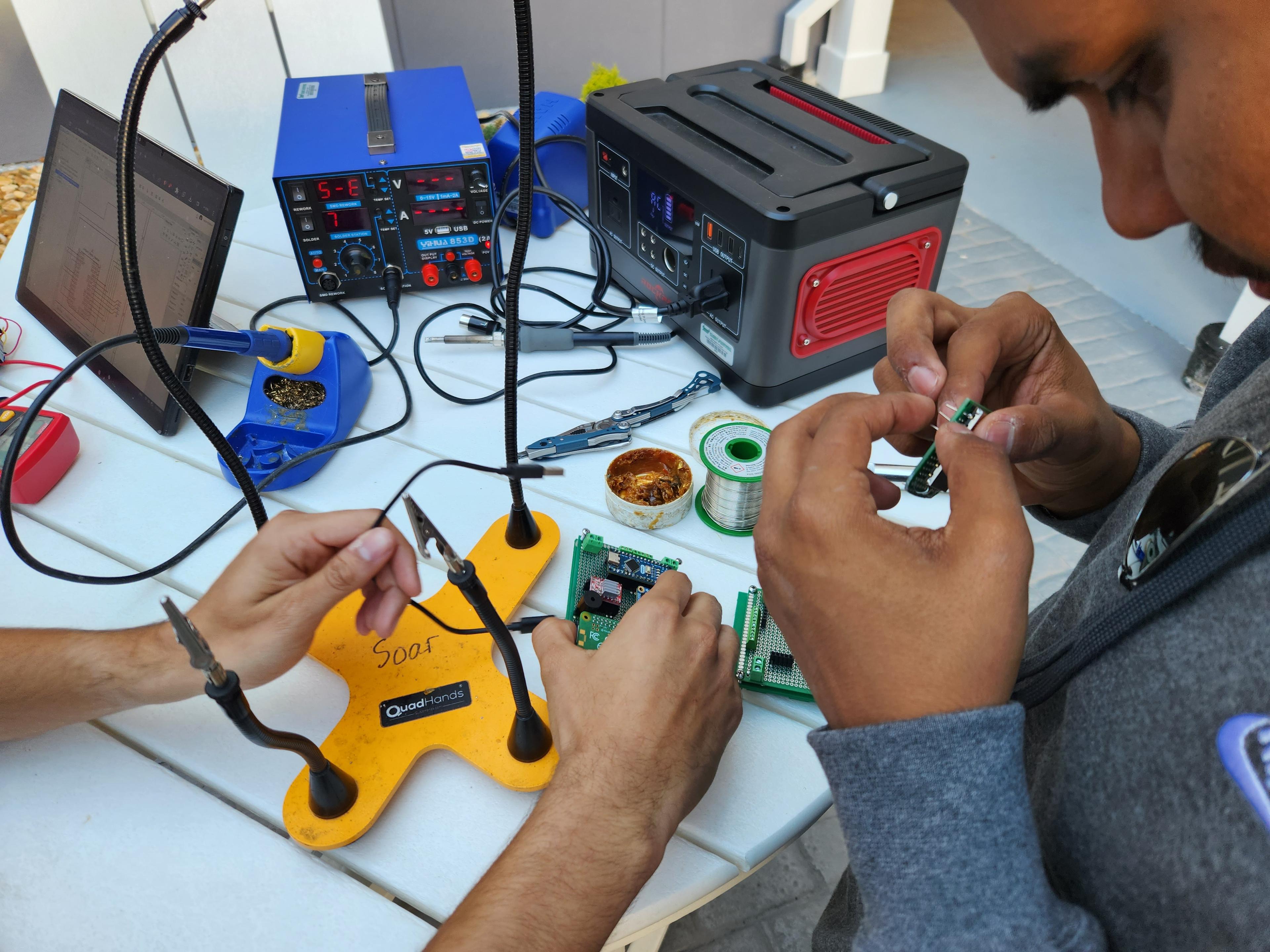
Designed for NASA Student Launch in Huntsville, AL, SOAR engineered a 115-inch G12 fiberglass rocket powered by a Cesaroni K520 motor. Upon landing, an onboard master-slave computing architecture autonomously aligned with an upward-facing airframe port, extended a 120° FOV camera on a 2-axis micro-stepper gimbal, leveled along the Z-axis, and executed radio-transmitted commands via APRS RF receiver.
Mission Photos & Media (1 of 3)
Technical Specifications
USLI Configuration- •Payload Upgrades: Redesigned actuator parts with 100% infill PETG, carbon steel rack-and-pinion gears, dual BNO055 IMUs for sensor redundancy, and foam-lined aerodynamic port covers.
- •Nosecone Ballast Integration: Added modular 24-oz stackable ballast system after subscale flight testing in Plant City, FL to ensure optimal off-the-rail stability margin (2.95 calibers).
- •Avionics Calibration & Isolation: Implemented shop barometric calibration and sensor housing isolation to eliminate discrepancies between primary and backup Missile Works RRC3 altimeters.
- •Ground Ejection Verification: Scaled black powder separation charges to 2.0g to ensure high-margin separation under all flight dynamics.
5,000 ft Target Apogee, Dynamic Apogee Adjustment (DAAS), & Autonomous Soil Rover
SOAR's 2018–2019 competition vehicle featured a 141-inch fiberglass rocket with active drag flaps (DAAS) and an autonomous soil-collection rover. Designed for a 5,000 ft apogee in Huntsville, AL, the rocket utilized a unique Payload Descent Leveling Subsystem (PDLS) to orient the upper airframe horizontally under parachute descent before landing, allowing a Recon Scout-inspired rover to eject remotely, travel 10+ ft, and flip itself over to vacuum a 10 mL soil sample.
Mission Photos & Media (1 of 1)

Technical Specifications
USLI Configuration- •Dynamic Apogee Adjustment (DAAS): Integrated 3 deployable aluminum drag fins driven by a 12V planetary geared motor and crank-slider mechanism in the 3" transition band to modulate cross-sectional area by up to 31%.
- •Payload Descent Leveling (PDLS): Solved 2018 mud-obstruction issues by firing a Tender Descender quick link at 550 ft to transfer parachute load to a lower bridle, dropping the payload tube horizontally before touchdown.
- •Inverted Vacuum Collection: Placed the soil intake on top of the rover to maintain maximum ground clearance during driving, programming the rover to flip itself over at the collection site to vacuum soil flush with the surface.
- •Steel-Bar Battery Retention: Replaced standard 9V clips with steel-bar-retained 3.7V 750 mAh LiPo batteries after subscale test flights in Plant City, FL (Apis III-S at 3,600 ft apogee) revealed clip detachment risks.
- •Quadruple Altimeter Redundancy: Two independent avionics bays each outfitted with dual Missile Works RRC3 altimeters and 902–928 MHz RTx GPS units armed via keyed rotary switches.
1-Mile Target Apogee (5,280 ft AGL) & Autonomous 'Sidewinder' Rover
Targeting an exact 1-mile apogee (5,280 ft AGL), SOAR designed and manufactured a 111-inch fiberglass launch vehicle equipped with a modular nose-cone ballast system. Upon landing, the rocket deployed the autonomous 'Sidewinder' rover using a motorized winch-and-sled mechanism to traverse deformable soil and unfold solar panels.
Mission Photos & Media (1 of 1)
Technical Specifications
USLI Configuration- •Fin Flutter Mitigation: Shortened fin height from 8" to 5.75" (14" root, 8.25" tip), increasing flutter boundary from 440 fps to ~808 fps, safely above projected 748 fps max velocity.
- •Payload Winch & Sled: Replaced complex rack-and-pinion with a high-torque stepper motor winch and push/pull solenoids for reliable rover ejection.
- •Extended Airframe (+17"): Lengthened rover compartment to 47.75" and altimeter bay to 12" to eliminate internal coupling stage and simplify recovery packaging.
- •Staggered Main Deployment: Separated main parachute deployments (950 ft and 800 ft) to eliminate shock cord entanglement discovered during subscale flight testing in Plant City, FL.
Autonomous Steerable Landing Module & Real-Time Computer Vision Target ID
SOAR's second NASA Student Launch entry featured a 145-inch (12-ft) G10 fiberglass rocket powered by a Cesaroni L1115 motor targeting 5,280 ft AGL. The vehicle deployed an autonomous 9.4-lb landing module mid-flight with motorized steering arms, spring-actuated landing gear with ground wheels, and an onboard OpenCV vision processing system to identify and classify colored ground targets in real time.
Mission Photos & Media (1 of 1)
Technical Specifications
USLI Configuration- •Autonomous Aerial Steering: Dual SunnySky brushless counter-rotating motors on spring-loaded 6061 aluminum Unistrut arms deployed horizontally upon ejection to counter parachute spin and steer toward target landing zones.
- •OpenCV Real-Time Color Classification: Raspberry Pi 3B executed HSV color masking and Canny edge contour filtering scaled by altitude to identify and differentiate three 40' x 40' colored ground tarps.
- •Phototransistor Sleep/Wake Architecture: Kept payload electronics in low-power sleep mode inside the dark airframe (40-hr battery reserve) until sunlight exposure upon ejection triggered full autonomous operation.
- •Piston Separation Ejection: Kraft phenolic piston system eliminated deployment bags, ensuring clean black-powder charge separation of the nose cone, lander, and booster sections.
- •Subscale Flight Verification: 2/3-scale prototype flight in Plant City, FL reached 1,899 ft apogee at 321 fps, validating separation dynamics and refining parachute packing to eliminate line entanglement.
Centennial Challenge MAV & Autonomous Ground Support Equipment (AGSE) System
USF SOAR's inaugural year competing in the NASA Student Launch featured Minotaur—a 138-inch single-stage Mars Ascent Vehicle (MAV) powered by a Cesaroni L910s motor targeting 5,280 ft AGL. Competing in the Centennial Challenge MAV category, the launch vehicle was paired with an Autonomous Ground Support Equipment (AGSE) system: a 6-wheeled Rocker-Bogie retrieval rover equipped with a 5-DOF stainless-steel robotic arm that autonomously located a sample payload on the ground, loaded it into a motorized 24" internal payload containment bay sealed flush with a linear actuator, erected the launch rail to 85° using a 100:1 non-backdrivable worm gear, and inserted the motor igniter—all completed in under 10 minutes.
Mission Photos & Media (1 of 1)
Technical Specifications
USLI Configuration- •Autonomous 6-Wheel Rocker-Bogie Rover: Modeled on NASA Mars rovers with 4-in steel-framed wheels; outer four wheels driven by optical-encoder DC motors via ROS navigation stack (amcl visual localization & costmaps), counterbalanced to prevent tipping.
- •5-DOF Stainless Steel Robotic Arm: 304 stainless steel arm with 7 Hitec servos, 18.3" horizontal reach, 22.9" vertical reach, and a liquid-rubber coated 4-tooth interlocking gripper with servo angle feedback for sample verification.
- •Kinect RGB-D Vision & Master PC: Onboard Raspberry Pi streaming Kinect 3D depth to an offboard MATLAB master PC for real-time sample color/shape identification and obstacle-avoidance trajectory calculation.
- •Mechanized Retracting Payload Bay: Radio-controlled Firgelli L16 linear actuator retracting the 24" fiberglass containment bay flush with an O-ring seal to eliminate external aerodynamic protrusions once the sample is loaded.
- •Automated Worm-Gear Erector & Igniter Inserter: Electric motor driving a 100:1 non-backdrivable worm gear generating 2,087 in-lb torque to lift the rail from horizontal to 85° with ratchet backup, paired with motorized elastomer friction rollers inserting the motor igniter.
- •Subscale Flight Verification: 3:4-scale prototype (93.2" length, 10.3 lb mass) successfully launched December 20, 2015, achieving 4,092 ft apogee (only 1.06% error vs. 4,136 ft OpenRocket prediction) with nominal dual deployment.
Legacy of Engineering Excellence
From our founding 2015-16 campaign through the 2024-25 season, NASA Student Launch has trained generations of USF aerospace, mechanical, electrical, and computer engineers. The avionics telemetry, active airbrakes, and deployable payload systems designed here continue to inform our current flagship vehicles in IREC and liquid propulsion research.