PAST IREC
Project Aurora (Team 24) • IREC 2025–2026 Competition Entry
Project Aurora Launch Vehicle
Project Aurora was designed, fabricated, and launched by the Society of Aeronautics and Rocketry (SOAR) at the University of South Florida for the 2026 International Rocket Engineering Competition (IREC) in Midland, Texas. Competing in the 10,000 ft COTS solid motor category, Aurora combines active aerodynamic airbrakes, custom long-range LoRa telemetry with motorized ground tracking, live video downlink, and an autonomous deployable 3U CubeSat rover.
Competition Gallery
Moments from the 2026 International Rocket Engineering Competition at Spaceport Midland
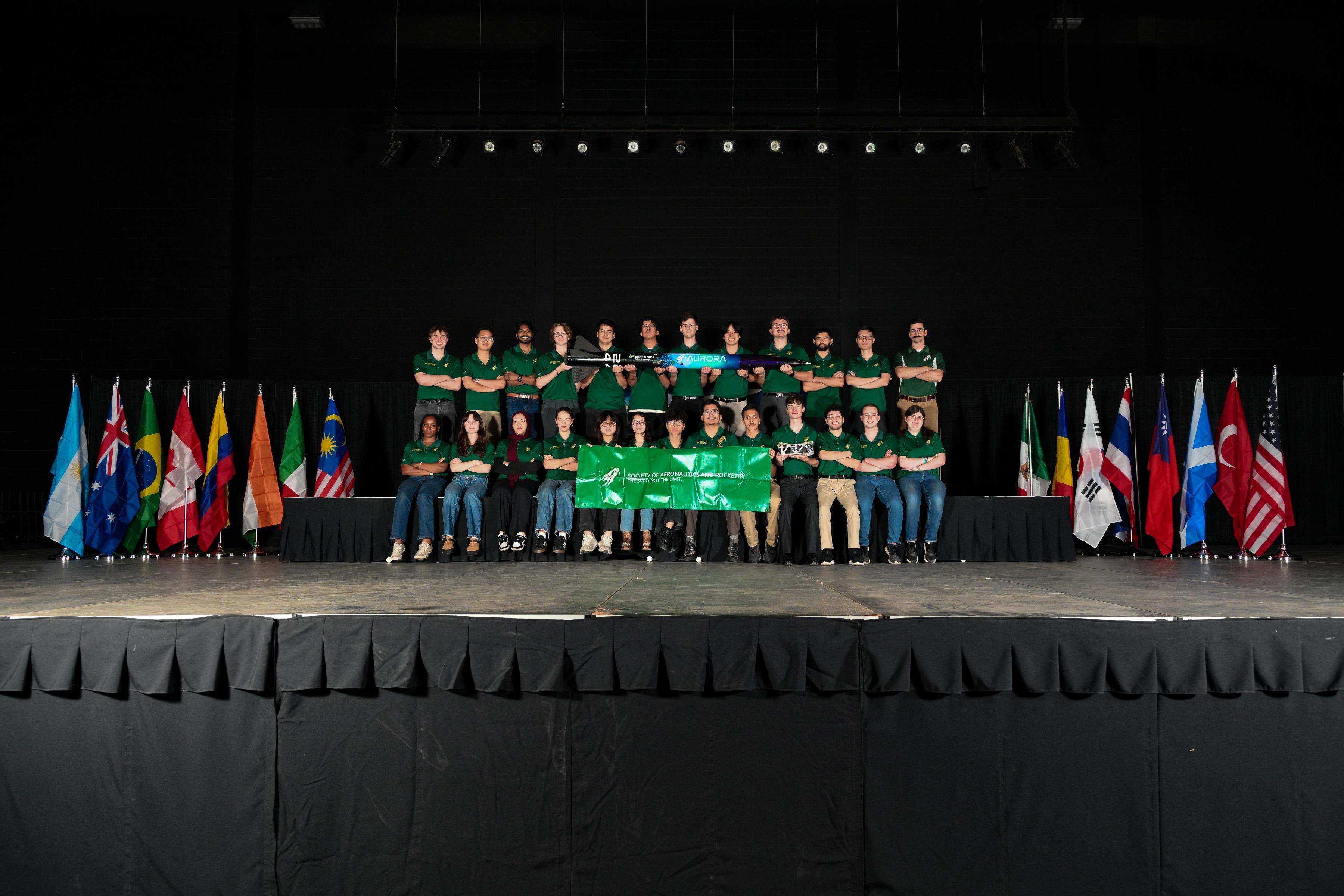
SOAR Project Aurora Team 24 at IREC
The USF Society of Aeronautics and Rocketry team presenting Project Aurora and the flight vehicle on stage alongside international competitors.
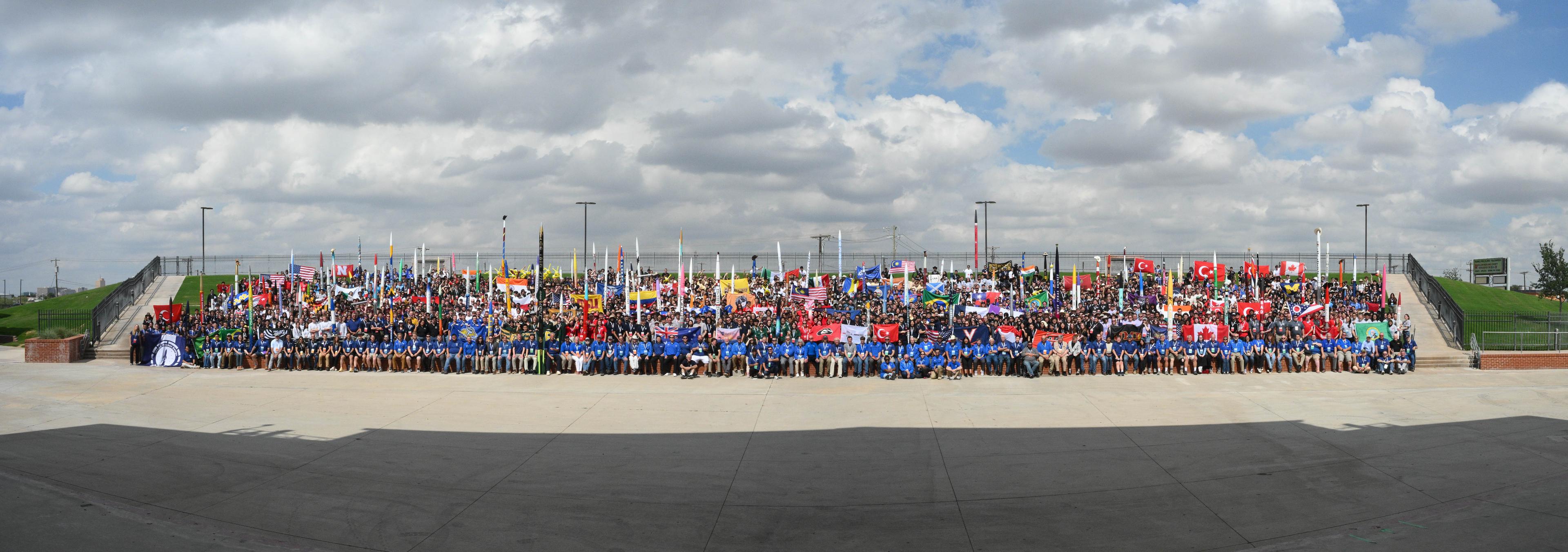
IREC International Gathering — Spaceport Midland, TX
Panoramic view of collegiate rocketry teams from across the globe assembled at the International Rocket Engineering Competition.
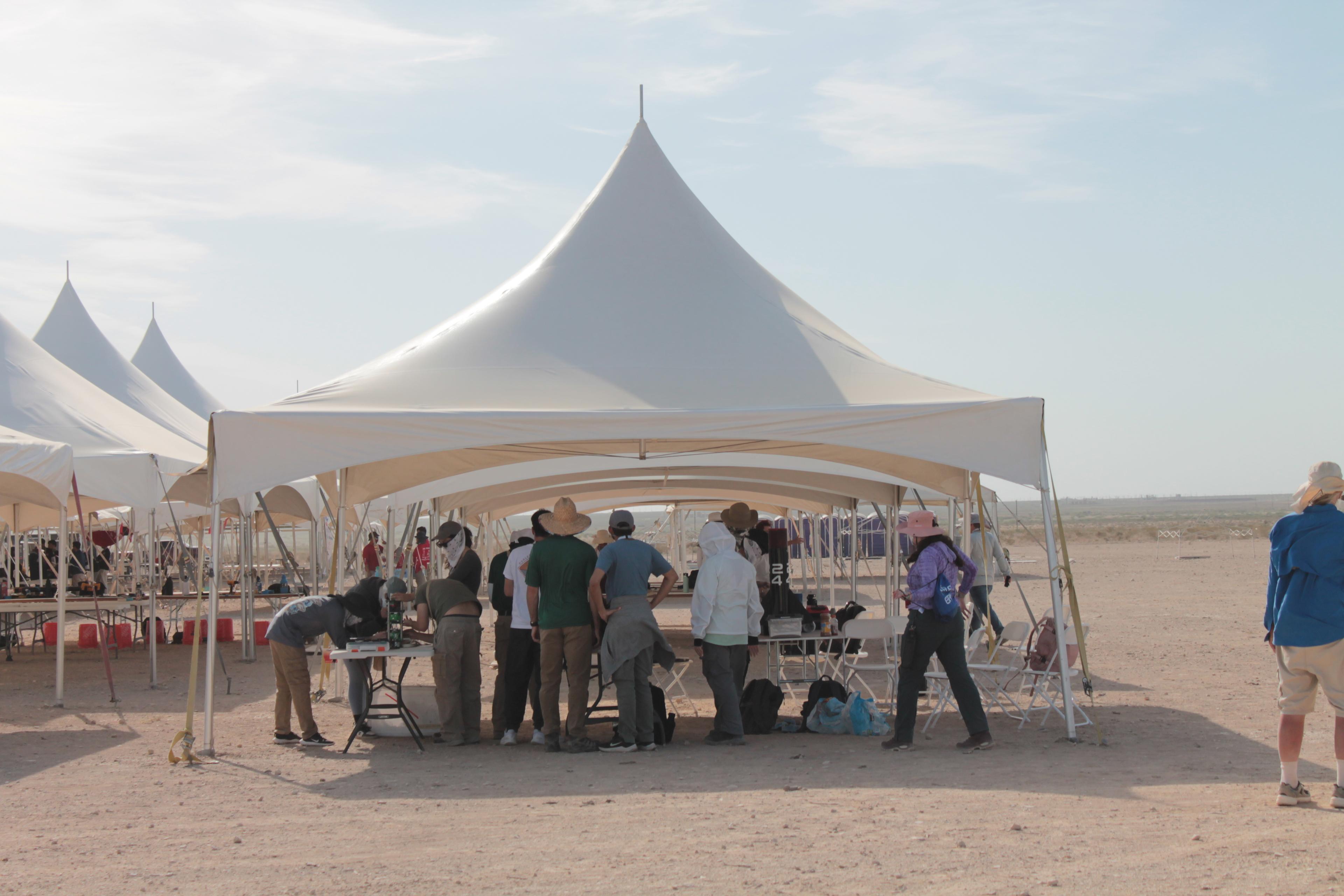
Project Aurora at Spaceport Midland
The SOAR team and Project Aurora during the 2025–26 IREC competition.
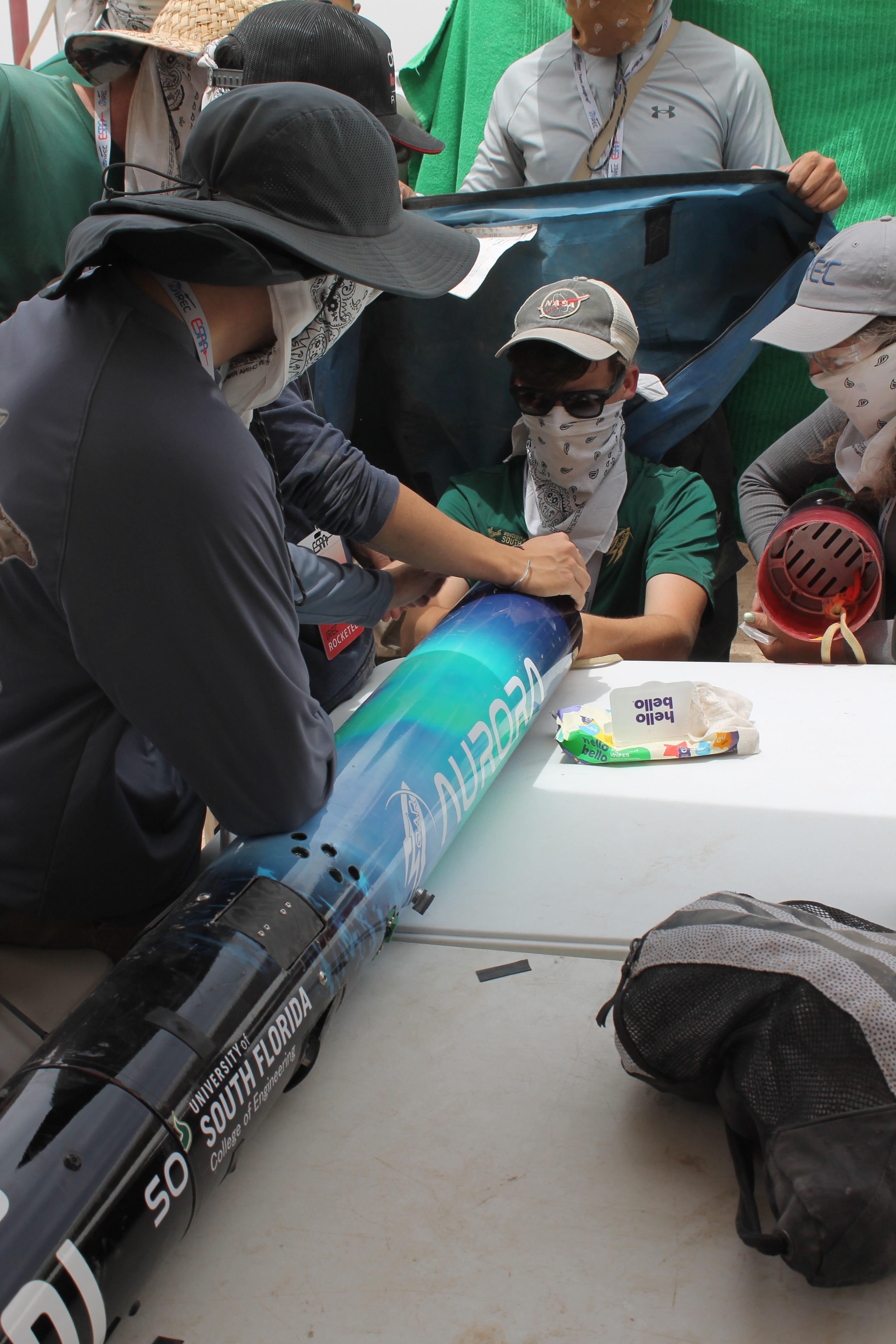
Aurora Launch Vehicle
Project Aurora prepared for competition operations at Spaceport Midland.
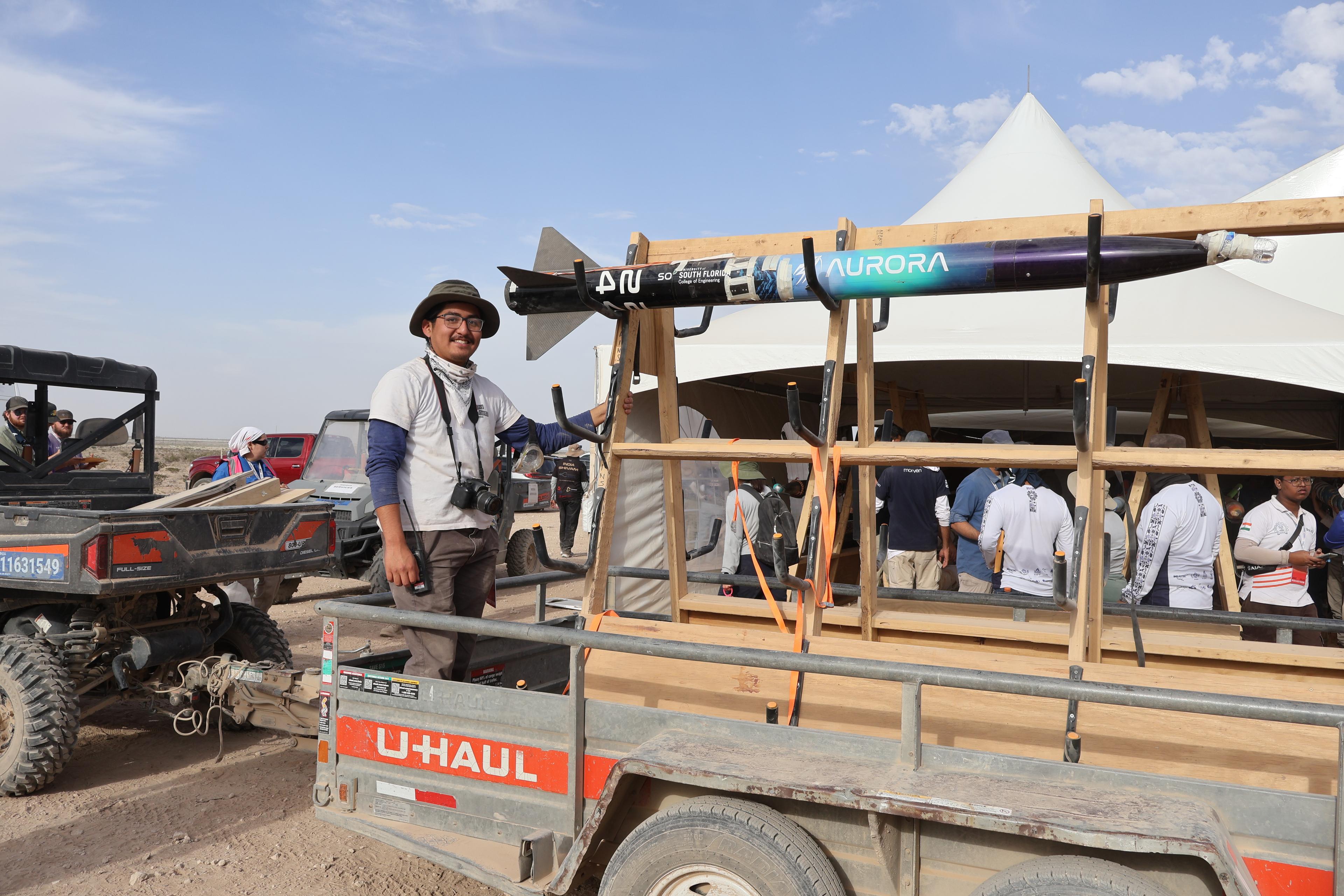
Team 24 Competition Operations
SOAR students working through launch-day preparations and vehicle integration.
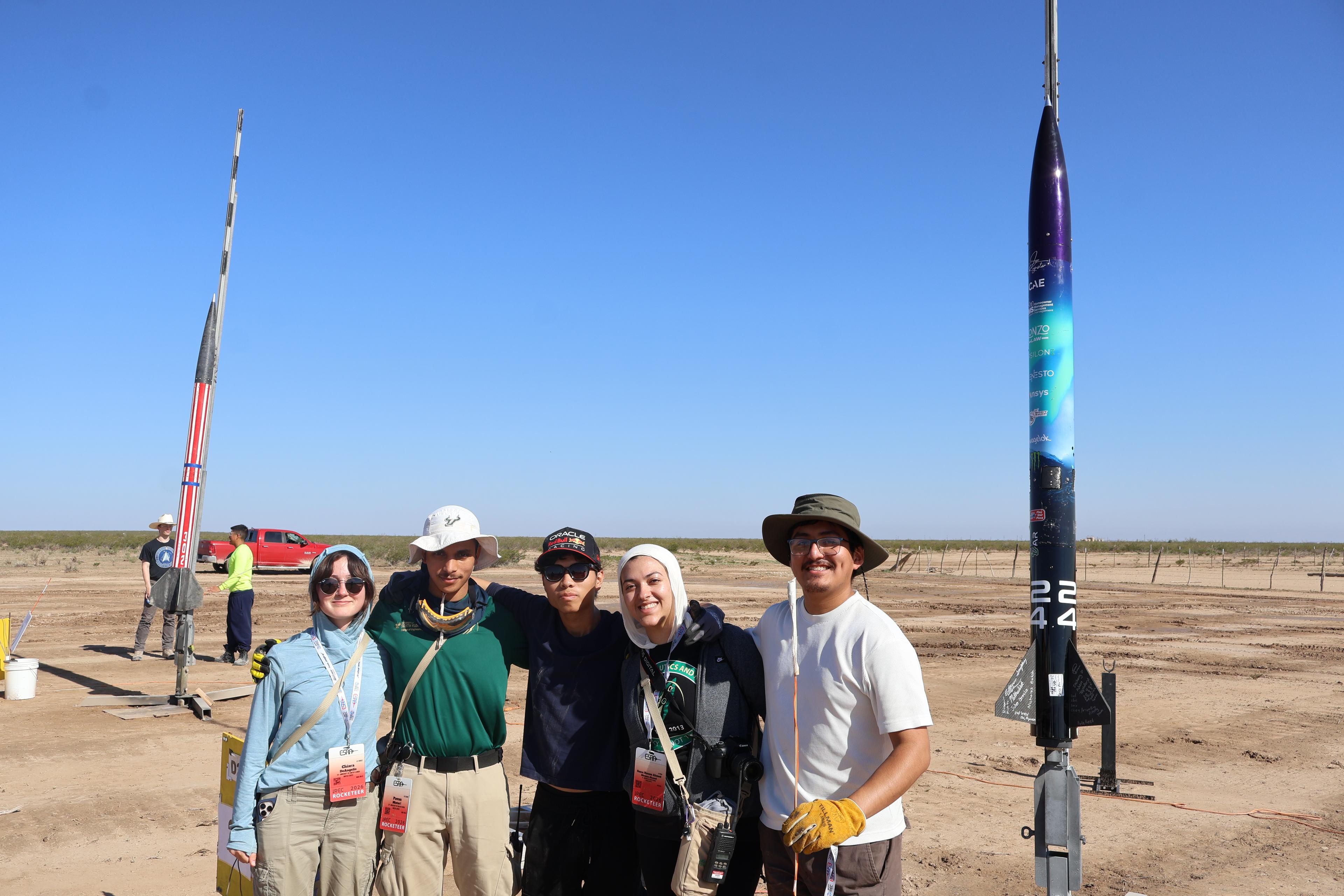
IREC Launch-Day Preparations
The Project Aurora team preparing the vehicle and its systems for flight.
Flight footage
Project Aurora Launch
Watch Project Aurora take flight during the 2025–26 IREC season.
About the IREC Mission
The International Rocket Engineering Competition (IREC) is the premier global collegiate rocketry competition hosted by the Experimental Sounding Rocket Association (ESRA). Held at Spaceport Midland in Texas, teams from across the world compete to accurately reach designated target altitudes, recover complex flight systems, and deploy functional scientific payloads.
SOAR entered Project Aurora (Team 24) into the 10,000 ft COTS (Commercial-Off-The-Shelf) Solid Rocket Motor category. To counteract variations in atmospheric density, motor burn, and wind conditions, the team engineered Aurora with an unbraked target apogee of 11,943 ft. Active aerodynamic airbrakes continuously monitor ascent energy and deploy conformal drag flaps during the coast phase to bleed excess speed and land precisely at the 10,000 ft target apogee.
At 1,000 ft AGL, Aurora ejects a dedicated 3U CubeSat containing the EVE (Earth Vegetation Evaluator) rover. Upon landing, EVE autonomously rolls out down a motorized ramp and executes an Edge AI NDVI plant health survey.
Vehicle Specifications
| Parameter | Specification & Design Value |
|---|---|
| Competition Class | 10,000 ft AGL Apogee — COTS Solid Rocket Motor |
| Rocket Dimensions | 101.4 in total length (100.0 in body tube) | 6.17 in OD (5.93 in ID fiberglass) |
| Mass Breakdown | Liftoff: 64.05 lbs (29.05 kg) | Propellant: 12.50 lbs | Payload: 8.59 lbs (3.90 kg) | Burnout: ~51.55 lbs |
| Solid Rocket Motor | AeroTech M1939W-PS White Lightning (98mm casing, 10,481.5 N·s total impulse, 5.4s burn, 1,939 N avg thrust) |
| Target & Unbraked Apogee | 10,000 ft AGL Target | 11,943 ft Unbraked OpenRocket simulation |
| Static Stability Margin | 2.15 to 2.80 calibers (CG @ 67.5 in, CP @ 80.8 in from tip of nose cone) |
| Airbrakes System | 4 Conformal flaps actuated by NEMA 23 stepper & inverted slider-crank linkages (0° to 48°) |
| Fin Assembly | Modular bolted fin can with 4 custom trapezoidal carbon fiber fins and CNC aluminum thrust ring |
| Recovery Architecture | Triple-redundant dual-deploy (3x Missile Works RRC3+ altimeters, drogue at apogee, 120" Fruity Chutes Toroidal Main at 1,000 ft) |
| Scientific Payload | 3U Aluminum CubeSat + EVE Rover with motorized rack-and-pinion ramp, RGB YOLO Edge AI, and NoIR NDVI camera |
| Telemetry & Downlink | Custom Teensy 4.1 + 430 MHz LoRa (200 mW amp), 2-axis motorized tracking ground station, 5.8 GHz VTX video with OSD |
Technical System Highlights
Core engineering innovations and flight subsystems engineered for Project Aurora:
Live Telemetry & Pan/Tilt Tracking
Custom Teensy 4.1 avionics suite downlinks real-time GPS, altitude, and sensor telemetry over 430 MHz LoRa boosted by a 200 mW RF amplifier to an autonomous motorized 2-axis pan/tilt Yagi ground station.
Live Video Downlink with OSD
5.8 GHz analog/digital video transmitter (VTX) delivering high-framerate onboard forward and downward video feeds with a real-time BetaFlight on-screen display (OSD) telemetry overlay.
Deployable 3U CubeSat & EVE Rover
3U aluminum CubeSat frame ejected at 1,000 ft AGL under a dedicated 52-inch chute. The autonomous 4WD EVE rover rolls out via a motorized rack-and-pinion ramp upon landing to conduct Edge AI and NDVI vegetation analysis.
Bolted Fin Structure with Carbon Fiber Fins
Modular bolted fin can assembly featuring four custom trapezoidal carbon fiber fins slotted into internal aluminum brackets and an aft anodized aluminum thrust ring transferring motor loads directly to the airframe.
Active Drag Airbrakes Subsystem
Four conformal curved aerodynamic flaps actuated by a NEMA 23 stepper motor via an inverted slider-crank mechanism (0° to 48°), regulated by a custom 4-layer PCB with Kalman filter state estimation targeting 10,000 ft AGL.
Triple-Redundant Dual Deployment Recovery
Three independent Missile Works RRC3+ altimeters on isolated LiPo circuits with magnetic arming switches and redundant black powder charges. Drogue deploys at apogee; 120-inch Fruity Chutes Toroidal Main at 1,000 ft.
Active Airbrakes Control
Designed to bridge the gap between Aurora's 11,943 ft unbraked potential and the 10,000 ft competition ceiling. The airbrakes feature four curved conformal flaps conforming to the 6.17-inch airframe outer diameter.
- •Actuation: High-torque NEMA 23 stepper motor driving an inverted slider-crank linkage for precise flap extension angles between 0° and 48°.
- •Avionics Hardware: Custom 4-layer PCB integrating a Raspberry Pi Zero 2 W, BMP580 precision barometer, BNO085 9-DOF IMU, and TMC2209 silent stepper driver.
- •Control Algorithm: Real-time Kalman state estimator coupled to aerodynamic CFD drag lookup tables to modulate deployment during coast phase.
3U CubeSat & EVE Rover
The payload bay houses a custom 6061-T6 aluminum 3U CubeSat chassis and the Earth Vegetation Evaluator (EVE) rover, deploying under its own 52-inch chute at 1,000 ft AGL.
- •Ejection & Descent: Mechanical separation at 1,000 ft with four spring-loaded suspension feet absorbing ground impact energy.
- •Autonomous Egress: Dual micro-gearmotors drive a rack-and-pinion deployment ramp rolling the 4WD rover out onto the terrain.
- •Vision & NDVI: Dual cameras (Visible Edge AI camera running YOLOv8 + Raspberry Pi NoIR with 550nm filter) calculate NDVI values to classify desert vegetation.
Testing & Verification
To verify mission reliability before shipping to Midland, the SOAR engineering team executed comprehensive ground, structural, and flight testing:
01. Ground Ejections
Pressure-transducer instrumented pyrotechnic separation tests validating black powder charge mass, shear pin shearing, and clean parachute clearance without structural shock damage.
02. Beard Garage Drop Tests
8-story drop testing from the USF Beard Parking Garage validating CubeSat suspension damping, landing orientation, and reliable autonomous EVE rover ramp deployment under impact forces.
03. Telemetry Longevity & Flight
11-hour continuous bench RF longevity stress test with the motorized tracking ground station, alongside subscale flight tests validating high-speed airbrake actuation and aerodynamic stability.
Project Leadership & Subsystems
Cross-disciplinary leadership team responsible for Project Aurora
Cesar Briones Aranda
Final authority on technical decisions, requirement verification, and subsystem flight readiness.
Pavan Moturi
Timeline scheduling, resource allocation, risk matrix management, and stakeholder communications.
Van Ninh Vu
Airframe integration, composite fin manufacturing, modular fin can, and structural FEA.
Minh Duc Nguyen
Inverted slider-crank linkages, conformal flap kinematics, and structural housing.
Christopher Michael Fernandez
Custom 4-layer PCB, Pi Zero 2 W companion computer, TMC2209 driver, and control algorithms.
Cooper Kenney
3U CubeSat chassis, spring suspension landing legs, and motorized rack-and-pinion deployment.
Chiara Alessandra Deangelis
Dual RGB Edge AI & NoIR camera payload, NDVI computer vision, and autonomous rover drive electronics.
Sama Hosam Ahmed Moussa Ahmed
Triple-redundant RRC3+ altimeter bays, pyrotechnic sizing, and dual-deployment parachute rigging.
Khoi Ton
Hazard analysis, PPE compliance, launch-day pre-flight checklists, and range safety protocols.
Alan Guyster
Live telemetry, ground station integration, and data visualization.
Special thanks to Team Mentor Jimmy Yawn, the SOAR Executive Board, and over 30 dedicated student engineers contributing across Aerostructures, Airbrakes, Avionics, Payload, Recovery, GSE, and Safety.
Competition Information
Technical Report
Official Project Technical Report for Project Aurora (Team 24)